Nov. 11-12, scholars from 15 countries gathered in Shanghai to discuss the future of European studies amid a turbulent global order.
The Dialog Global European Studies in World Disorder: New Dynamics and New Perspectives, a sub-forum of the 24th Conference on International Exchange of Professionals, ran from November 11 to 12. It was organized by the Shanghai Academy of Global Governance and Area Studies (SAGGAS) under Shanghai International Studies University (SISU).Representatives from think tanks, universities and businesses in China, the United States, Russia, Germany, Kazakhstan, India, Japan, South Korea, Poland and other countries exchanged views on new agendas, methods and paradigms for European studies.
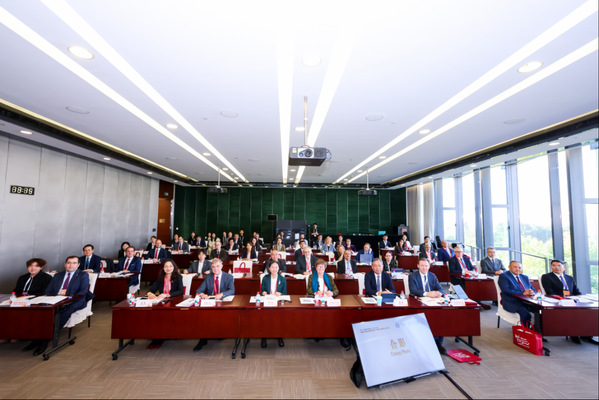
At the opening ceremony, SISU signed two cooperation documents: a memorandum with the Suleimenov Institute of Oriental Studies of Kazakhstan to establish a joint research center for the China-Kazakhstan community with a shared future, and a three-year plan with the Development Strategy Center of Uzbekistan for a parallel China-Uzbekistan center. Both cover joint research, scholar exchanges and young talent training.
Six scholars delivered keynote speeches covering science diplomacy, the European factor in China-Russia relations, economic security, East Asian peace, empire studies and monetary security. Two roundtables on crises and opportunities amid international disorder followed, touching on the EU's role in a multipolar world, risks and openings in the global economy, Eurasian connectivity and the weakening of international organizations.
On November 12, two parallel sessions met simultaneously at England Hall, SISU's Hongkou Campus, and Room 517 of the Shanghai Expo Center. The subforum European Security Policy and Europe-Asia Cooperation examined Europe's security concept, the reshaping of the European security order, European security and Asia, and practical paths for Europe-Asia cooperation. The Eurasian Studies Forum discussed interdisciplinary Eurasian studies, the reconfiguration of the Eurasian order, and Eurasian economic, social and cultural issues.
Participants called for studying Europe within the broader Eurasian and global context, and for deeper Europe-Asia academic exchanges built on mutual respect, equal dialogue and interdisciplinary cooperation.